
Tropical Weather Definitions and Strengths
Here is a breakdown of some common tropical weather terms in plain, everyday language, ordered from the earliest building blocks to the strongest storms.
The Starting Blocks (Potential Storms)
- Tropical Wave: Think of this as a "ripple" or a bump of low pressure in the atmosphere traveling from east to west. It brings some rainy weather and is often the very first seed that can grow into a bigger storm.
- Tropical Disturbance: This is a cluster of thunderstorms that stays together for at least 24 hours. It’s a bit more organized than a wave, but it doesn't have a distinct circular spin yet.
- Invest: Short for "investigation." This isn't a official storm type; it just means weather centers have put a webcam or a magnifying glass on an area of bad weather. They want to run computer models and collect data on it because it might develop, not because it definitely will.
The Official Tropical Cyclones (Ordered by Wind Speed)
Once a system develops a clear circular spin and a defined center, it becomes a "tropical cyclone" and moves through these official stages based entirely on wind speed:
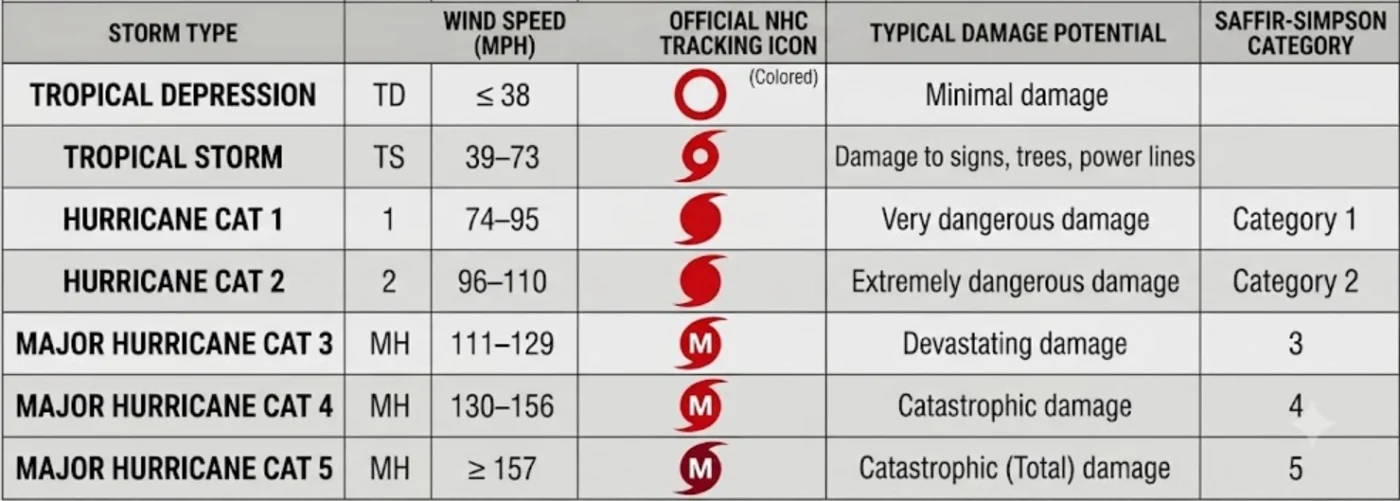
- Tropical Depression: The storm now has a spinning center, but it's weak. Max winds are 38 mph or less.
- Tropical Storm: The storm is getting its act together and gets an official name. Winds are stronger, ranging from 39 to 73 mph.
- Hurricane: A powerful, mature storm with a well-defined center (often forming an "eye"). Winds reach 74 mph or higher.
- Major Hurricane: The most dangerous of the bunch. These are hurricanes that reach Category 3, 4, or 5, with devastating winds of 111 mph or higher.